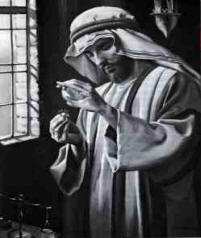
The Pearl
[This chapter is based on Matt. 13:45, 46.]
The blessings of redeeming love our Savior compared to a precious pearl. He illustrated
His lesson by the parable of the merchantman seeking goodly pearls "who, when he had
found one pearl of great price, went and sold all that he had, and bought it." Christ
Himself is the pearl of great price. In Him is gathered all the glory of the Father, the
fullness of the Godhead. He is the brightness of the Father's glory and the express image
of His person. The glory of the attributes of God is expressed in His character. Every
page of the Holy Scriptures shines with His light. The righteousness of Christ, as a pure,
white pearl, has no defect, no stain. No work of man can improve the great and precious
gift of God. It is without a flaw. In Christ are "hid all the treasures of wisdom and
knowledge." Col. 2:3. He is "made unto us wisdom, and righteousness, and
sanctification, and redemption." 1 Cor. 1:30. All that can satisfy the needs and
longings of the human soul, for this world and for the world to come, is found in Christ.
Our Redeemer is the pearl so precious that in comparison all things else may be accounted
loss.
Christ "came unto His own, and His own received Him not." John 1:11. The
light of God shone into the darkness of the world, and "the darkness comprehended it
not." John 1:5. But not all were found indifferent to the gift of heaven. The
merchantman in the parable represents a class who were sincerely desiring truth. In
different nations there were earnest and thoughtful men who had sought in literature and
science and the religions of the heathen world for that which they could receive as the
soul's treasure. Among the Jews there were those who were seeking for that which they had
not. Dissatisfied with a formal religion, they longed for that which was spiritual and
uplifting. Christ's chosen disciples belonged to the latter class, Cornelius and the
Ethiopian eunuch to the former. They had been longing and praying for light from heaven;
and when Christ was revealed to them, they received Him with gladness.
In the parable the pearl is not represented as a gift. The merchantman bought it at the
price of all that he had. Many question the meaning of this, since Christ is represented
in the Scriptures as a gift. He is a gift, but only to those who give themselves, soul,
body, and spirit, to Him without reserve. We are to give ourselves to Christ, to live a
life of willing obedience to all His requirements. All that we are, all the talents and
capabilities we possess, are the Lord's, to be consecrated to His service. When we thus
give ourselves wholly to Him, Christ, with all the treasures of heaven, gives Himself to
us. We obtain the pearl of great price.
Salvation is a free gift, and yet it is to be bought and sold. In the market of which
divine mercy has the management, the precious pearl is represented as being bought without
money and without price. In this market all may obtain the goods of heaven. The treasury of the jewels of truth is open to all.
"Behold, I have set before thee an open door," the Lord declares, "and no
man can shut it." No sword guards the way through this door. Voices from within and
at the door say, Come. The Saviour's voice earnestly and lovingly invites us: "I
counsel thee to buy of Me gold tried in the fire, that thou mayest be rich." Rev.
3:8, 18.
The gospel of Christ is a blessing that all may possess. The poorest are as well able
as the richest to purchase salvation; for no amount of worldly wealth can secure it. It is
obtained by willing obedience, by giving ourselves to Christ as His own purchased
possession. Education, even of the highest class, cannot of itself bring a man nearer to
God. The Pharisees were favored with every temporal and every spiritual advantage, and
they said with boastful pride, We are "rich, and increased with goods, and have need
of nothing"; yet they were "wretched, and miserable, and poor, and blind, and
naked." Rev. 3:17. Christ offered them the pearl of great price; but they disdained
to accept it, and He said to them, "The publicans and the harlots go into the kingdom
of God before you." Matt. 21:31.
We cannot earn salvation, but we are to seek for it with as much interest and
perseverance as though we would abandon everything in the world for it.
We are to seek for the pearl of great price, but not in worldly marts or in worldly
ways. The price we are required to pay is not gold or silver, for this belongs to God.
Abandon the idea that temporal or spiritual advantages will win for you salvation. God
calls for your willing obedience. He asks you to give up your sins. "To him that
overcometh," Christ declares, "will I grant to sit with Me in My throne, even as
I also overcame, and am set down with My Father in His throne." Rev. 3:21.
There are some who seem to be always seeking for the heavenly pearl. But they do not
make an entire surrender of their wrong habits. They do not die to self that Christ may
live in them. Therefore they do not find the precious pearl. They have not overcome unholy
ambition and their love for worldly attractions. They do not take up the cross and follow
Christ in the path of self-denial and sacrifice. Almost Christians, yet not fully
Christians, they seem near the kingdom of heaven, but they cannot enter there. Almost but
not wholly saved, means to be not almost but wholly lost.
The parable of the merchantman seeking goodly pearls has a double significance: it
applies not only to men as seeking the kingdom of heaven, but to Christ as seeking His
lost inheritance. Christ, the heavenly merchantman seeking goodly pearls, saw in lost
humanity the pearl of price. In man, defiled and ruined by sin, He saw the possibilities
of redemption. Hearts that have been the battleground of the conflict with Satan, and that
have been rescued by the power of love, are more precious to the Redeemer than are those
who have never fallen. God looked upon humanity, not as vile and worthless; He looked upon
it in Christ, saw it as it might become through redeeming love. He collected all the
riches of the universe, and laid them down in order to buy the pearl. And Jesus, having
found it, resets it in His own diadem. "For they shall be as the stones of a crown,
lifted up as an ensign upon His land." Zech. 9:16. "They shall be Mine, saith
the Lord of hosts, in that day when I make up My jewels." Mal. 3:17.
But Christ as the precious pearl, and our privilege of possessing this heavenly
treasure, is the theme on which we most need to dwell. It is the Holy Spirit that reveals
to men the preciousness of the goodly pearl. The time of the Holy Spirit's power is the time when in a special sense the heavenly gift is sought and
found. In Christ's day many heard the gospel, but their minds were darkened by false
teaching, and they did not recognize in the humble
Teacher of Galilee the Sent of God. But after Christ's ascension His enthronement in
His mediatorial kingdom was signalized by the outpouring of the Holy Spirit. On the day of
Pentecost the Spirit was given. Christ's witnesses proclaimed the power of the risen
Saviour. The light of heaven penetrated the darkened minds of those who had been deceived
by the enemies of Christ. They now saw Him exalted to be "a Prince and a Saviour, for
to give repentance to Israel, and forgiveness of sins." Acts 5:31. They saw Him
encircled with the glory of heaven, with infinite treasures in His hands to bestow upon
all who would turn from their rebellion. As the apostles set forth the glory of the
Only-Begotten of the Father, three thousand souls were convicted. They were made to see
themselves as they were, sinful and polluted, and Christ as their friend and Redeemer.
Christ was lifted up, Christ was glorified, through the power of the Holy Spirit resting
upon men. By faith these believers saw Him as the One who had borne humiliation,
suffering, and death that they might not perish but have everlasting life. The revelation
of Christ by the Spirit brought to them a realizing sense of His power and majesty, and
they stretched forth their hands to Him by faith, saying, "I believe."
Then the glad tidings of a risen Saviour were carried to the uttermost bounds of the
inhabited world. The church beheld converts flocking to her from all directions. Believers
were reconverted. Sinners united with Christians in seeking the pearl of great price. The
prophecy was fulfilled, The weak shall be "as David," and the house of David
"as the angel of the Lord." Zech. 12:8. Every Christian saw in his brother the
divine similitude of benevolence and love. One interest prevailed. One object swallowed up
all others. All hearts beat in harmony. The only ambition of the believers was to reveal
the likeness of Christ's character, and to labor for the enlargement of His kingdom. "The
multitude of them that believed were of one heart and of one soul. . . . With great power
gave the apostles witness of the resurrection of the Lord Jesus; and great grace was upon
them all." Acts 4:32, 33. "And the Lord added to the church daily such as should
be saved." Acts 2:47. The Spirit of Christ animated the whole congregation; for they
had found the pearl of great price.
These scenes are to be repeated, and with greater power. The outpouring of the Holy
Spirit on the day of Pentecost was the former rain, but the latter rain will be more
abundant. The Spirit awaits our demand and reception. Christ is again to be revealed in
His fulness by the Holy Spirit's power. Men will discern the value of the precious pearl,
and with the apostle Paul they will say, "What things were gain to me, those I
counted loss for Christ. Yea doubtless, and I count all things but loss for the excellency
of the knowledge of Christ Jesus my Lord." Phil. 3:7, 8.
|